Supporting a Child With ADHD Without Doing Everything for Them
Supporting a Child With ADHD Without Doing Everything for Them
By Mary Parker, LPC-S | Clinical Director, Infinite Potential
You check every backpack pocket, remember every deadline, and remind your child about the same morning tasks until you’re tired of hearing yourself. You want them to become more independent. You also know what happens when you step back too quickly: missing materials, unfinished work, and a difficult start to the day.
Helping a child with ADHD build independence means teaching a manageable responsibility, providing support they can use, and gradually adjusting your involvement as they gain skill. A checklist, a consistent place for belongings, or a reminder may remain useful even as your child takes more ownership. The American Academy of Pediatrics describes structure and organization as ways to help children develop competence. HealthyChildren.org
Find the step your child needs help with
“Get ready for school” sounds like one task, but it includes several: find clothes, get dressed, locate the folder, pack the bag, and notice when it’s time to leave. Before handing over the whole routine, look at where it tends to stop.
Your child may know what belongs in the backpack but lose track after going to another room. They may pack the bag and leave it on the kitchen floor. Or they may avoid checking the folder because it contains work they’re worried about. Each pattern points to a different place to start.
Ask your child, “Which part is hardest to remember or get through?” Then observe the routine together. Their answer and what you notice may not match at first. You can use both.
A backpack handoff you can try
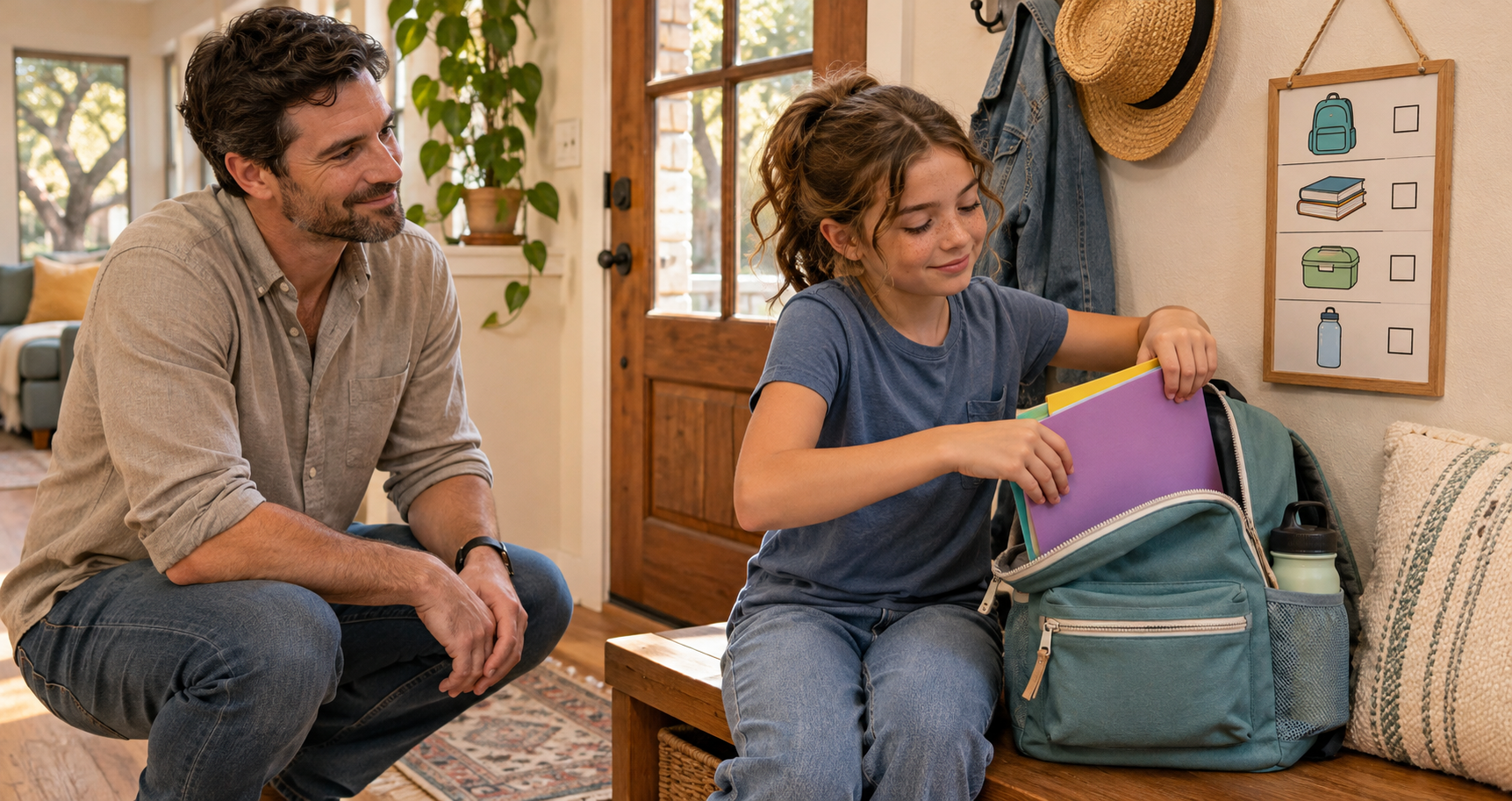
Choose a responsibility with room for practice. For this example, the goal is to put the homework folder in the backpack after homework, then leave the bag at its usual departure spot.
1. Make the first responsibility small
Start with the folder rather than every item needed for school. Tell your child what you’re practicing:
“After homework, your job is to put the folder in your backpack. I’ll help you practice the routine.”
A specific direction gives you both a clear finish point. Clear instructions, routines, and organizational support are among the strategies CDC recommends for families managing ADHD. CDC
2. Practice together when you have time
At the end of homework, demonstrate once if needed. Then let your child handle the folder and bag. Place a short written or picture cue where the folder usually sits.
You might ask, “What happens to the folder now?” If your child still isn’t sure, point to the cue or walk through the step together. Keep your help focused on the part they need.
3. Change one part of your help at a time
Once the routine becomes more familiar, try replacing a spoken reminder with a gesture toward the cue. Later, see whether your child notices the cue without your prompt. You can keep a brief check-in while reducing how much directing you do.
There’s no fixed deadline for this. If the folder is still missed, ask what happened before removing more support. Was the bag out of reach? Did another activity interrupt the sequence? Would practicing at a different point in the evening work better?
4. Notice what your child did
Keep feedback specific: “You put the folder away before starting your game.” That tells your child which action you noticed. If you use an agreed reward, make the expectation clear and keep it achievable. Positive feedback and predictable expectations can be part of an ADHD support plan. CDC
What if the handoff falls apart?
Suppose the folder gets packed for several days, then disappears under a pile of papers. Review that moment: “The folder didn’t make it into the bag yesterday. Let’s see where it got left.”
You might discover that the new worksheet didn’t fit in the folder, or that the usual cue was covered. Fixing that obstacle is more actionable than repeating, “You need to remember.” If the routine has become a source of arguments, return to a calmer practice session and a smaller responsibility.
A child can also be ready for one part while still needing help with another. They might pack independently but need an adult to check an unfamiliar school requirement. That’s useful information about what to teach next.
Independence looks different for a teenager
A teen may be more willing to try a plan they helped choose. Ask which part of your involvement feels helpful and which feels intrusive. You might agree to check assignments together twice a week instead of asking about them repeatedly each evening. Or your teen might choose an electronic reminder and agree to tell you when they need help.
Be clear about what you will still supervise. Start with a responsibility where practice is manageable; keep age-appropriate oversight for medication, driving, and other safety-sensitive tasks. Routines and parental involvement can continue to support independence during adolescence. HealthyChildren.org
How our Mind–Brain–Body approach guides parent support
At Infinite Potential, we look at the task and the experience around it. Mind: Is the child expecting criticism or worried about making a mistake? Brain: Which part of the routine requires support—starting, remembering, sequencing, or returning after an interruption? Body: What do the family and child notice about energy, sleep, tension, or when the task is being attempted?
We also look at the parent’s workload. A plan that requires you to monitor everything more closely may be difficult to sustain. Together, we can look for a support that is visible at the point of use and a check-in that fits the family’s day.
Mary Parker’s Wired for the Wild offers further perspective on ADHD and supporting different minds. One useful question to bring to this routine is: “What support would help my child practice the next step themselves?”
When counseling can help
Consider parent support or child counseling when routines repeatedly lead to conflict, your child expects to fail before trying, or you’re unsure how much responsibility to hand over. Counseling can make space for both skill practice and the frustration that has built around it.
Parent training in behavior management is an established part of ADHD care. CDC describes it as helping caregivers learn strategies to support behavior and strengthen the parent-child relationship. If you’re seeking a specific parent-training program, ask the clinician what training and services they offer. CDC
For another concrete starting point, read How to Break a Big Task Into Real Steps. You can also explore family counseling when the recurring interaction has become as difficult as the task itself.
ADHD counseling and parent support near Georgetown, TX
Infinite Potential welcomes Georgetown families at our Round Rock office. We work with children ages five and up, teens, and adults, with parent support when useful. Families also come from Austin, Cedar Park, Leander, Hutto, Pflugerville, and surrounding Central Texas communities.
Ask about child counseling and parent support, contact Infinite Potential, or call 512-230-3740 to discuss appointment options.
You can begin with: “I’m managing so much of the routine that I don’t know how to step back without everything falling apart.” That gives us a place to start.
About the author
Mary Parker, LPC-S, is the Clinical Director of Infinite Potential in Round Rock, Texas, and author of Wired for the Wild. Her work connects ADHD support with the routines and relationships families navigate every day. Hear more on The Infinite Potential Podcast.
This article provides general education and does not replace individualized mental health care.
