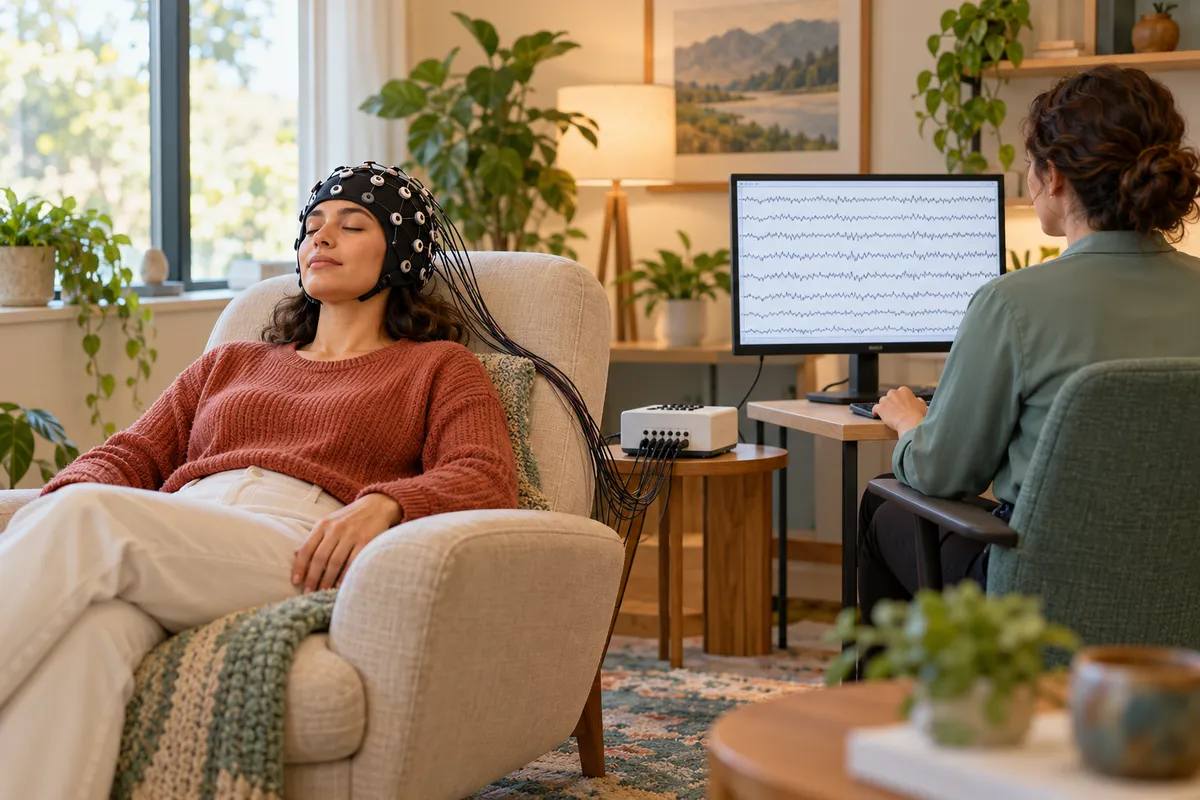
What Happens During a qEEG Brain Map? | Hutto, TX
What Happens During a qEEG Brain Map? A Step-by-Step Guide
By Mary Parker, LPC-S | Clinical Director, Infinite Potential
If you are considering neurofeedback, you may be curious about the brain map that comes first.
Will it hurt? What does the cap do? Do you have to concentrate? What can the results tell you?
A qEEG brain map involves recording electrical activity from sensors placed on the scalp, then analyzing selected features of that recording. At Infinite Potential, we use 19-channel qEEG brain mapping as one source of information for individualized neurofeedback planning.
The recording is noninvasive. The sensors listen to electrical signals at the scalp; they do not send electricity into your brain.
Here is what to expect, how to prepare, and how we connect the information to the goals that brought you in.
What Is a qEEG Brain Map?
EEG stands for electroencephalography, a method of recording electrical activity at the scalp.
The “q” means quantitative. Computer analysis is used to summarize aspects of the EEG recording, such as the amount of activity within particular frequency ranges and how patterns vary across recording locations.
Depending on the analysis, results may also be compared with a reference database.
The colorful images often called “brain maps” are visual summaries of selected measurements. They are not photographs of the brain, and they are not the same as an MRI.
A useful explanation of your results should connect the measurements to the recording conditions, your history, and the questions being considered.
Why Start With Brain Mapping?
People come to Infinite Potential with different priorities. One person may want to work on attention during demanding tasks. Another may be interested in sleep, stress regulation, or performance.
Brain mapping gives us a structured way to collect EEG information before discussing an individualized neurofeedback plan.
We consider that information alongside questions such as:
What would you like to work toward?
When do difficulties show up?
What have you already tried?
What is your relevant health and treatment history?
How will we recognize meaningful progress?
The map contributes information to that conversation. Your experience and goals remain central.
What Happens During a Brain-Mapping Appointment?
1. We Discuss Your History and Goals
The process begins with understanding why you are seeking services.
Instead of stopping at “I want better focus,” it helps to describe the situation:
“I lose track of what I’m doing during paperwork.”
“My child has a difficult time settling into homework.”
“I want to understand the options for supporting recovery after demanding workdays.”
These examples help clarify what you hope to change. They do not assume that a particular EEG pattern explains the difficulty.
Tell the team about relevant diagnoses, medications, sleep concerns, previous treatment, and anything that may affect your comfort during the recording.
2. The Recording Cap Is Positioned
For a 19-channel recording, electrodes are arranged across standardized scalp locations.
Conductive gel or paste helps the sensors make a usable connection with the scalp. The team checks those connections before collecting the recording.
You may notice the cap’s fit or the sensation of conductive material being applied. Tell the person assisting you if anything feels uncomfortable.
The electrodes record activity. They do not inject anything, penetrate the skull, or deliver electrical stimulation.
3. You Sit Quietly During Recording Periods
Depending on the protocol, recording periods may include eyes open and eyes closed.
You will receive instructions about what to do. You do not need to produce a “good” brainwave pattern or demonstrate how well you can concentrate.
The goal is to obtain usable information under the requested conditions.
Movement, blinking, jaw tension, and muscle activity can affect the signal. Staff may ask you to adjust your position, relax your jaw, or repeat part of the recording.
A repeated segment is a recording-quality decision—not a sign that you did something wrong.
4. The Cap Is Removed
After recording, the cap and sensors are removed. Some conductive material may remain in your hair.
Ask the team what cleanup to expect and whether you should plan time to wash your hair afterward.
The appointment also includes setup and checks, so the total visit is longer than the recording alone. Confirm the expected appointment length when scheduling.
5. The Recording Is Reviewed and Analyzed
Collecting the recording is only part of the process.
The raw EEG needs review so that movement, muscle activity, poor connections, and other interference are considered before quantitative results are interpreted.
Selected usable portions can then be analyzed. The resulting information may include frequency patterns, comparisons across locations, and other measures relevant to the analysis.
Ask when your results will be available and what the review appointment includes.
Does qEEG Brain Mapping Hurt?
The EEG recording itself is painless and noninvasive.
The cap may feel snug, and applying conductive material can feel unfamiliar. People with scalp sensitivity or sensory concerns may find the setup more noticeable.
Let us know about those concerns before the appointment. Understanding what feels difficult helps us discuss preparation, pacing, and whether the process is appropriate for you.
For a child, a simple explanation can help:
“The cap has little sensors that record signals from your head. We’ll explain each step, and you can tell us how it feels.”
Avoid promising that a child will not notice anything. A realistic explanation gives them room to communicate.
How Should You Prepare for a qEEG Brain Map?
Follow the specific instructions provided by Infinite Potential. General EEG preparation commonly includes arriving with clean, dry hair without styling products that could interfere with sensor contact.
Before your visit:
Ask which hair products to avoid.
Share your current medication and supplement list.
Ask about caffeine and other appointment-specific instructions.
Tell the team if your sleep was unusual or you feel unwell.
Discuss scalp sensitivity, sensory needs, or difficulty sitting still.
Confirm the total appointment length and results-review process.
Do not stop or change prescribed medication on your own to prepare for brain mapping. If any adjustment is being considered, it should be coordinated with the prescribing clinician.
There is no benefit to trying to make your recording look a particular way. Accurate information about your circumstances helps put the results in context.
What Do the Colors on a Brain Map Mean?
Depending on the report, colors may represent the relative amount of a measurement or its difference from a reference value.
A color needs a legend and an explanation.
Red does not automatically mean damage, and blue does not automatically mean healthy. A different display or measurement may use colors differently.
A useful review should explain:
What the particular image measures.
What its scale represents.
Which recording conditions were used.
What conclusions are reasonable.
What remains uncertain.
How the information relates to the proposed plan.
You should be able to ask questions without needing to understand the technical vocabulary beforehand.
Can a Brain Map Diagnose ADHD, Anxiety, Autism, or Depression?
A qEEG brain map does not independently establish those diagnoses.
EEG patterns can overlap across people with different experiences and conditions. A measurement also needs to be interpreted in the context of the person and the recording.
For ADHD specifically, the American Academy of Neurology’s practice advisory states that commonly discussed EEG measures, including the theta/beta ratio, should not replace a standard clinical evaluation.
At Infinite Potential, the purpose of brain mapping is to contribute information to neurofeedback planning—not to label someone from a colored image.
If you need a diagnostic evaluation, discuss the appropriate assessment pathway with a qualified clinician.
How Is Brain Mapping Different From Neurofeedback?
Brain mapping gathers and analyzes information. Neurofeedback uses ongoing EEG recording to provide feedback during training.
During neurofeedback, selected aspects of the EEG signal influence visual or auditory feedback. The training protocol determines what is being measured and how feedback is delivered.
At Infinite Potential, mapping information is considered alongside your goals and history when planning training.
Before beginning, ask:
“What are we targeting?”
“Why does that target fit my goals?”
“How will we review my response?”
Research on neurofeedback differs across conditions, protocols, and outcomes. That makes a clear explanation of the proposed approach and its relevant evidence useful when deciding whether to proceed.
You can explore Infinite Potential’s brain mapping and neurofeedback services here.
What Happens After the Results Review?
The next conversation should translate the information into understandable options.
That may include discussing:
Whether neurofeedback fits your goals.
The proposed training approach.
Scheduling and costs.
How your response will be monitored.
When the plan will be reviewed.
Whether other professional support would be useful.
A good plan includes goals you can recognize outside the appointment.
For example, “better regulation” may need a more specific description: recovering after a stressful interaction, sustaining attention during a particular activity, or following a more workable evening routine.
Those descriptions help keep the focus on daily functioning.
How Do We Look for Progress?
Changes in a recording can be part of the review, but everyday changes matter.
We want to understand whether you are noticing differences in the areas that led you to seek services.
Depending on your goals, that conversation might include sleep, attention, stress recovery, school participation, work demands, or performance.
If repeat mapping is considered, ask what question it is intended to answer. Comparing recordings requires attention to recording conditions and quality. A different-looking map alone does not establish that a meaningful benefit has occurred.
Your feedback helps guide the ongoing discussion.
Our Mind–Brain–Body Approach
At Infinite Potential, our approach reflects Mind. Brain. Body. Infinite Potential.
We consider EEG information as one part of a broader picture that includes your experiences, routines, relationships, health history, and goals.
A person seeking help with focus may also be navigating disrupted sleep, demanding responsibilities, or ongoing worry. We do not assume that a map identifies the sole cause of those experiences.
In my book, The Basics of Functional Mental Health: Understanding Functional Mental Health, I explore a whole-person perspective on mental health. That perspective supports asking broader questions while being clear about what each service can contribute.
Brain mapping provides EEG information. Counseling offers a place to work on emotional and behavioral concerns. Other health questions may require evaluation by an appropriate medical professional.
We help you explore a plan that fits the concerns and priorities you bring.
For more educational conversations about our broader approach, visit The Infinite Potential Podcast.
Questions to Ask Before Booking
You do not need to know the technical terminology to make an informed decision.
Start with these questions:
What does the brain-mapping appointment include?
How should I prepare?
Who reviews the recording and explains the results?
What is included in the fee?
How will the information be used?
What happens if the recording needs to be repeated?
How would a proposed training plan connect to my goals?
Our team can explain the current process and help you decide on a next step.
Frequently Asked Questions About qEEG Brain Mapping
Does the Cap Send Electricity Into My Head?
No. EEG electrodes record electrical activity at the scalp. Recording is different from electrical stimulation.
Is Brain Mapping the Same as an MRI?
No. An MRI produces images of brain structure. EEG records electrical activity, and qEEG analysis summarizes selected features of that recording.
Can the Map Read My Thoughts?
No. EEG records electrical signals. It does not reveal the words you are thinking or read your private thoughts.
What If I Blink or Move?
Those actions can affect the recording. Staff monitor signal quality and may repeat a segment when needed. You will receive instructions throughout the process.
Do I Need to Stop My Medication?
Do not stop or change prescribed medication on your own. Share your medication list and follow preparation instructions coordinated with the appropriate clinician.
Can Children Have a Brain Map?
Children can participate in EEG recording, but comfort, developmental needs, and the ability to obtain usable data matter. Ask our team about suitability and preparation for your child.
Will One Map Tell Me Everything About My Brain?
No. A qEEG recording samples electrical activity under particular conditions. It provides one type of information, which needs context and explanation.
How Many Neurofeedback Sessions Will I Need?
A brain map does not provide a guaranteed session count or outcome. Ask about the recommended starting plan, review points, costs, and how decisions about continued training are made.
qEEG Brain Mapping Near Hutto, Texas
If you live in Hutto and are considering brain mapping, Infinite Potential’s Brain Performance & Optimization Center is located in Round Rock.
We welcome inquiries from Hutto, Austin, Georgetown, Cedar Park, Leander, Pflugerville, and surrounding Central Texas communities.
Whether you are exploring services for yourself or your child, you can begin with a conversation about your goals and questions.
Call 512-230-3740 or visit our brain mapping and neurofeedback page to ask about current appointments, preparation, pricing, and what the process includes.
About the Author: Mary Parker, LPC-S
Mary Parker, LPC-S, is the Clinical Director of Infinite Potential in Round Rock, Texas. She is a Licensed Professional Counselor Supervisor, Certified Integrative Mental Health Provider, Certified Neurofeedback Provider, and Functional Mental Health Practitioner with more than 15 years of experience supporting children, adolescents, adults, and families.
Through Infinite Potential’s Mind. Brain. Body. approach, Mary brings a whole-person perspective to counseling, neurofeedback services, and mental health education.
She is the author of The Basics of Functional Mental Health and Wired for the Wild: How ADHD Is Your Biological Superpower, and co-author with Dr. Natalie Ledbetter of The Perimenopause Prescription: A Holistic Guide to Hormonal Harmony.
Mary hosts The Infinite Potential Podcast, formerly known as Reinventing Mental Health.
Explore Mary’s Work
Sources and Further Reading
This article provides general education and does not replace individualized medical or mental health care. qEEG does not independently diagnose psychiatric or neurological conditions.
