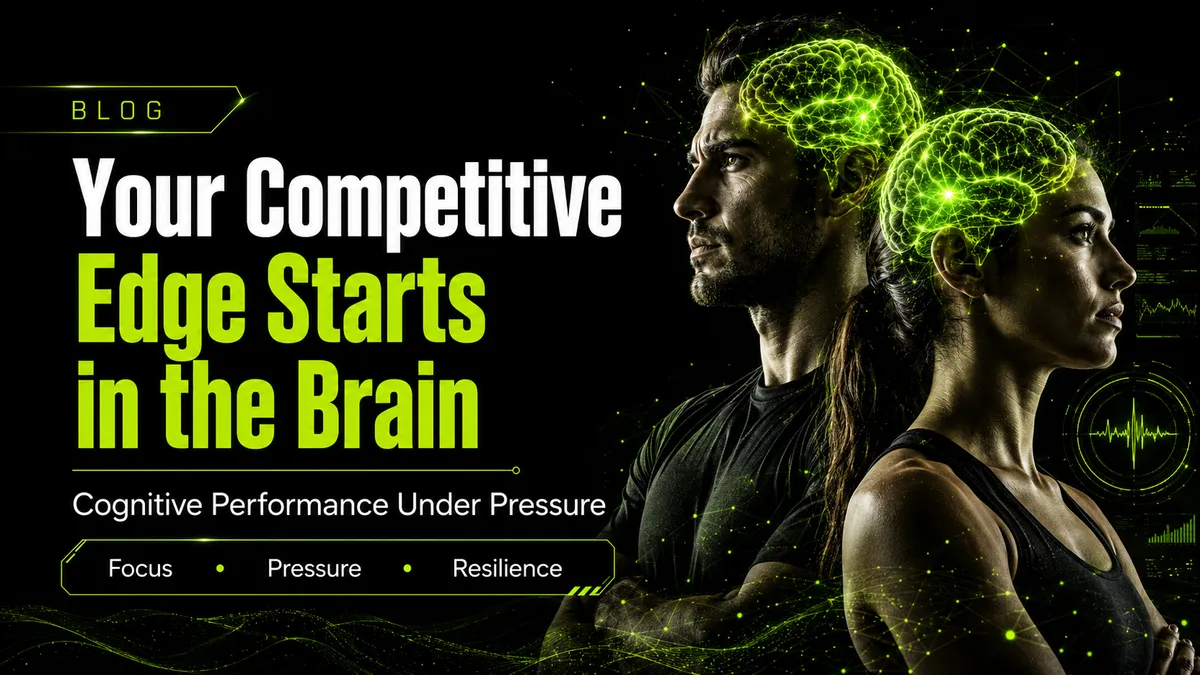
Your Competitive Edge Starts in the Brain: Cognitive Performance Under Pressure
Your Competitive Edge Starts in the Brain: Cognitive Performance Under Pressure
What separates a good performance from an exceptional one?
Talent matters.
Preparation matters.
Experience matters.
But when two people have similar skills, the difference may come down to something less visible:
How effectively the brain performs when the pressure rises.
At Infinite Potential – A Brain Performance & Optimization Center, we are interested in the brain behind performance.
How does it focus?
How quickly does it adapt?
How does it respond to stress?
How well does it recover after intense effort?
These questions matter whether you are leading a company, competing in a sport, building a business, taking an exam, performing on stage, or navigating any environment where the stakes feel high.
Pressure Changes the Performance Environment
A task can feel very different when consequences increase.
You may be able to make a decision easily during practice but hesitate when the outcome matters.
You may know the material but struggle to recall it during an important presentation.
You may perform perfectly during training and become mentally scattered in competition.
Pressure can influence attention, emotional regulation, decision-making, and perception.
The goal is not to eliminate pressure.
For many high performers, pressure is unavoidable.
The goal is learning how to function effectively within it.
What Does Cognitive Performance Include?
Cognitive performance is broader than intelligence.
It can include:
- Focus
- Working memory
- Processing speed
- Decision-making
- Mental flexibility
- Pattern recognition
- Emotional regulation
- Reaction and response
- Cognitive endurance
High performance depends on being able to access these abilities when they are actually needed.
Focus Under Pressure
Pressure competes for attention.
Instead of focusing only on the task, the brain may begin processing additional information:
What if I fail?
What will people think?
What happens if this goes wrong?
Am I performing well enough?
These thoughts can pull cognitive resources away from execution.
One component of mental performance is therefore learning to direct attention back toward the information that matters most.
Adaptability Is an Underrated Performance Skill
Plans change.
Markets change.
Competitors change.
The play breaks down.
Technology fails.
Unexpected information appears.
Peak performance requires more than following a perfect plan.
It requires cognitive flexibility.
A high-performing brain needs to recognize when a strategy is no longer working and shift without becoming overwhelmed by the change.
That ability can be especially valuable for executives, athletes, entrepreneurs, and professionals operating in fast-moving environments.
Why Regulation Matters
Being calm is not always the goal.
Sometimes performance requires intensity.
Sometimes it requires aggression, urgency, confidence, or high energy.
The important skill is regulation—the ability to access an appropriate state for the situation rather than being controlled by whatever state appears automatically.
A flexible brain can activate when needed and recover when the demand is over.
How Neurofeedback May Support Brain Training
Neurofeedback uses sensors to monitor brainwave activity and provide real-time visual or auditory feedback.
The process is non-invasive and does not deliver electrical stimulation into the brain.
Over repeated sessions, the brain receives information about its own activity and has an opportunity to practice patterns associated with regulation.
High performers may explore neurofeedback as part of a broader program with goals related to:
- Focus
- Cognitive consistency
- Mental flexibility
- Stress regulation
- Recovery
- Performance under pressure
Results vary by individual, and neurofeedback should not be viewed as a guaranteed method of improving performance.
Brain Mapping: Measure Before You Optimize
Optimization becomes more meaningful when you understand the starting point.
Brain mapping may provide additional information about patterns of electrical brain activity.
At Infinite Potential, that information may help guide more individualized conversations about performance goals and training.
This is similar to what already happens in many high-performance fields.
Athletes measure physical metrics.
Businesses measure operational metrics.
Executives measure outcomes.
Brain mapping brings another layer of information into the performance conversation.
Build Your Mental Performance System
Technology alone does not create peak performance.
The strongest approach is usually a system.
That system may include:
Sleep
Protect the recovery that supports tomorrow’s cognitive performance.
Focus Training
Create regular opportunities for uninterrupted concentration.
Stress Regulation
Develop strategies for shifting between high activation and recovery.
Physical Health
Movement, nutrition, and general health can influence how you feel and perform.
Reflection
Review what conditions produced your best and worst performances.
Brain Training
Consider tools such as neurofeedback when they align with your goals and appropriate professional guidance.
Your Brain Is Part of Your Competitive Advantage
High performers often invest heavily in everything around performance.
Equipment.
Coaching.
Education.
Systems.
Analytics.
Technology.
But the system interpreting all of that information and making every final decision is the brain.
Understanding and training that system may provide a different perspective on optimization.
At Infinite Potential, our goal is to help individuals explore the relationship between brain function, focus, resilience, regulation, recovery, and high-level performance.
Because your competitive edge may not simply come from doing more.
It may come from helping your brain perform better when it matters most.
Think sharper. Adapt faster. Perform under pressure.
Contact Infinite Potential to learn more about our Neuro Peak Performance programs.
This article is for educational purposes only and is not intended to diagnose, treat, cure, or prevent any medical or mental-health condition. Individual neurofeedback and performance outcomes vary.
